
Education
Faith & mental health: Light at the end of the tunnel

Mental health is an integral part of anyone’s well-being, in fact, it is just as important as any other facet of a person’s health. To a degree, no one is immune from it, as it is quite simply a part of human nature.
According to an estimate, 1 in 7 i.e., 14% of 10–19 year-olds globally experience mental health conditions. Here, in United Kingdom, health experts have warned that the country is facing a mental health crisis, and have called for the ‘staggering demand’ to be addressed urgently.
The National Health Service (NHS) paints a sobering picture, revealing a troubling uptick in mental health issues among British youth. In November 2023, NHS figures show a record 496,897. under-18’s had been referred by a GP for treatment under Child and Adolescent Mental Health Services.
Depression, with its gripping tendrils, casts shadows over the brightest souls. The World Health Organization (WHO) reports a global rise in depression and anxiety rates, highlighting the need for holistic approaches. Recent studies reveal a startling surge in mental health challenges among the youth
in Britain, including Muslim communities. According to the National Health Service (NHS) 1in5, children and young people in the UK experiences a mental health issue each year. The reasons are multifaceted the relentless pace of life, societal pressures, and the isolating impact of technology. For Muslim youth, the struggle is compounded as they grapple with the clash between cultural expectations
and the pull of their Islamic identity.
Amid the cacophony of daily life, the sense of isolation intensifies. The digital era, which promised unprecedented connectivity, paradoxically fosters a disconnect that seeps into the core of individual experiences. A survey conducted by the Mental Health Foundation found that 42% of young people in Britain feel lonely, a sentiment that echoes across cultural and religious boundaries. Muslim youth, too, face the challenge of forging meaningful connections without compromising their values.
The statistics lay bare a profound narrative—one that demands our attention and understanding.
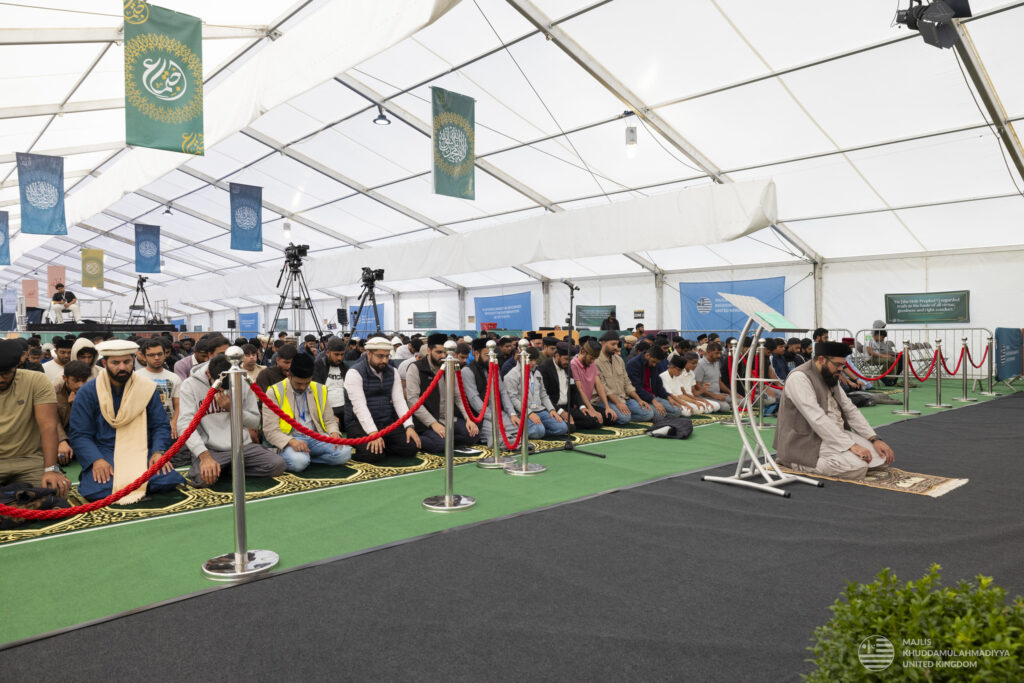
In contemplating the matter, one wonders: Can our khuddam, dedicated to the regularity of daily prayers, grapple with mental health challenges like depression and anxiety?
Delving into this inquiry, insights emerged during our informal gatherings in the ‘Ask the Murabbi’ sessions, where fellow brothers can didly recounted instances of experiencing symptoms associated with depression and anxiety. Thus, the question surfaces: How do we navigate this turbulent sea of emotions ?
Being Ahmadi Muslims, we have the privilege of seeking guidance and solutions for our problems from the Holy Qur’an and constant guidance from our Beloved Khalifa, Hazrat Mirza Masroor Ahmad (aba ) based on the teachings of Islam. On one occasion Huzoor (aba) mentioned the following of the Holy Qur’an said: اَلَّذِیۡنَ اٰمَنُوۡا وَتَطۡمَئِنُّ قُلُوۡبُہُمۡ بِذِکۡرِ اللّٰہِ ؕ اَلَا بِذِکۡرِ اللّٰہِ تَطۡمَئِنُّ الۡقُلُوۡبُ ﴿ؕ۲۹﴾ ‘It is in the remembrance of Allah that hearts can find comfort.’

Explaining the verse he further stated, ‘we should turn to Allah and beseech help and support from Him. Islam also guides us to increasingly participate in social activities after such events. Those who are suffering from depression are also told by psychiatrists to go and socialise with others – to get some fresh air and exercise, and to meet people instead of being isolated.’Islam, with its emphasis on community, offers a roadmap for nurturing bonds that transcend the superficiality of social media. Holy Prophet
Muhammad (peace be upon him) said, ‘A believer to another believer is like a building whose
different parts enforce each other.’
Engaging with the community becomes not only a source of support but also a means of dispelling the shadows of isolation.
Furthermore, Islam advocates self-reflection and seeking refuge in prayer during moments of despair. In
the Quran, Allah assures,‘Therefore remember Me, and I will remember you.’
The act of remembrance, through prayer and mindfulness, becomes a sanctuary for the restless mind, offering solace and tranquillity in the face of life’s tribulations. To address mental health challenges among the youth, it is crucial to dismantle the stigma associated with seeking professional help. Islam encourages the pursuit of knowledge, and counselling or therapy is an avenue through which individuals can gain a deeper understanding of themselves. Holy Prophet Muhammad (peace be upon him) himself sought counsel from trusted companions, exemplifying the importance of seeking wisdom in times of confusion.
As the sun sets over the urban landscape, casting long shadows that mirror the complexity of contemporary life, the call to action is clear. This can only be happen if we have strong relationship with
Khilafat. By fostering genuine connections, engaging in self-reflection, and dismantling the stigma surrounding mental health, they can navigate the maze of challenges while staying true to their faith.






Editorial
Condition 3 of Bai‘at: Offering Prayers & Durood
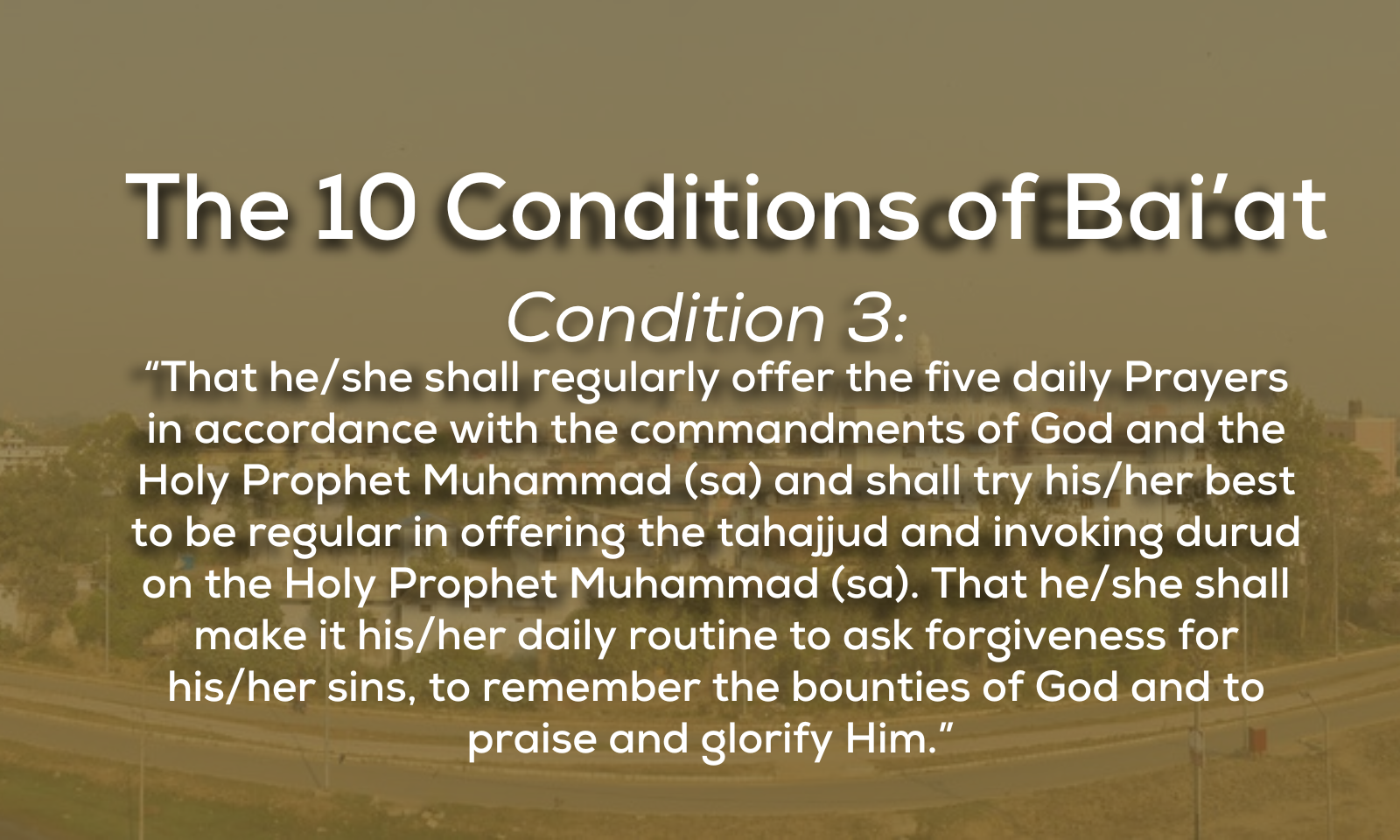
“That he/she shall regularly offer the five daily Prayers in accordance with the commandments of God and the Holy Prophet Muhammadsa and shall try his/her best to be regular in offering the tahajjud and invoking durud on the Holy Prophet Muhammadsa. That he/she shall make it his/her daily routine to ask forgiveness for his/her sins, to remember the bounties of God and to praise and glorify Him.”
Recently, at Jalsa Salana Qadian, Hazrat Khalifatul Masih Vaba instructed that the Ten Conditions of Bai‘at should be hung up in our homes and that we should strive to abide by them strictly. These conditions define what it truly means to be an Ahmadi Muslim, and for Khuddam especially, they guide us to a life of closeness to Allah.
The third condition of Bai‘at brings our focus to Salat. Observing the 5 daily Prayers is not presented as an option. Rather, it is obligatory. Allah commands:
وَاَقِیۡمُوا الصَّلٰوۃَ وَاٰتُوا الزَّکٰوۃَ وَاَطِیۡعُوا الرَّسُوۡلَ لَعَلَّکُمۡ تُرۡحَمُوۡنَ ﴿۵۷﴾
“And observe Prayer and give the Zakat, and obey the Messenger, that you may be shown mercy”
—(Holy Qur’an, Surah al-Nur, 24:57)
Prayer is the daily meeting with Allah that structures a believer’s entire life. Hazrat Khalifatul Masih Vaba reminds us that there is no concession in abandoning Prayer; even in travel or illness. In whatever state we are in, prayer is always necessary.
For Khuddam who are preoccupied in their work, their families or their friends, Salat often takes the back seat. Yet the Holy Prophet Muhammadsa warned that neglecting Prayer draws a person dangerously close to disbelief (Sahih Muslim, Kitab-ul-Iman). He also declared, “The comfort of my eyes is in Salat” (Sunan al-Nasai). This contrast is striking: what many see as a burden was the greatest source of peace for the Holy Prophetsa. The issue is not time, but priority.
The Promised Messiahas repeatedly emphasised that Prayer is the key to all good fortune and that its essence lies in heartfelt supplication, not empty form (Ruhani Khazain, vol. 3, p. 549; vol. 14, p. 241). Prayer without humility and concentration becomes a routine, but Prayer offered as if one stands before Allah transforms the soul. He warned that allegiance without fulfilling these obligations is of no benefit (Malfuzat, vol. 3, p. 627).
This condition also draws attention to tahajjud, the voluntary Prayer offered at night. Allah commands the Holy Prophet(sa),
وَمِنَ الَّیۡلِ فَتَہَجَّدۡ بِہٖ نَافِلَۃً لَّکَ ٭ۖ عَسٰۤی اَنۡ یَّبۡعَثَکَ رَبُّکَ مَقَامًا مَّحۡمُوۡدًا ﴿۸۰﴾
“And offer tahajjud with the recitation of the Qur’an in a part of the night as a supererogatory service for thee”
—(Holy Qur’an, Surah Bani Israil, 17:80).
Tahajjud demands sacrifice, but that sacrifice produces sincerity. The Holy Prophetsa described it as a means of nearness to Allah, protection from sin, and purification of the soul (Sunan al-Tirmidhi). The Promised Messiahas instructed that even two rak‘at, offered consistently, can awaken spiritual pain and devotion, which become the means of acceptance (Malfuzat, vol. 2, p. 182).
Sending durud upon the Holy Prophet Muhammadsa is another central pillar of this condition. Allah declares,
اِنَّ اللّٰہَ وَمَلٰٓئِکَتَہٗ یُصَلُّوۡنَ عَلَی النَّبِیِّ ؕ یٰۤاَیُّہَا الَّذِیۡنَ اٰمَنُوۡا صَلُّوۡا عَلَیۡہِ وَسَلِّمُوۡا تَسۡلِیۡمًا ﴿۵۷﴾
“Allah and His angels send mercy on the Prophet. O ye who believe! You also should invoke blessings on him”
—(Holy Qur’an, Surah al-Ahzab, 33:57)
The Holy Prophetsa promised that invoking blessings upon him brings Allah’s mercy tenfold (Sahih Muslim). The Promised Messiahas explained that no divine grace reaches a person without the intermediation of the Holy Prophetsa, and that abundant durud sets divine grace into motion (Al-Hakam, February 28, 1903).
Istighfar, seeking forgiveness, is described as spiritual strength training. Allah says,
فَقُلۡتُ اسۡتَغۡفِرُوۡا رَبَّکُمۡ ؕ اِنَّہٗ کَانَ غَفَّارًا ﴿ۙ۱۱﴾یُّرۡسِلِ السَّمَآءَ عَلَیۡکُمۡ مِّدۡرَارًا ﴿ۙ۱۲﴾وَّیُمۡدِدۡکُمۡ بِاَمۡوَالٍ وَّبَنِیۡنَ وَیَجۡعَلۡ لَّکُمۡ جَنّٰتٍ وَّیَجۡعَلۡ لَّکُمۡ اَنۡہٰرًا ﴿ؕ۱۳﴾
“Seek forgiveness of your Lord; for He is the Exceedingly Forgiving, He will send down rain for you in abundance, And He will strengthen you with wealth and with children, and He will give you gardens and He will give you rivers.”
—(Holy Qur’an, Surah Nuh, 71:11–13)
The Holy Prophetsa taught that istighfar provides a way out of difficulties and grants provision from unexpected sources (Sunan Abi Dawud). The Promised Messiahas explained that istighfar suppresses the roots of sin and restores the soul to purity and strength (Ruhani Khazain, vol. 12, pp. 346–347).
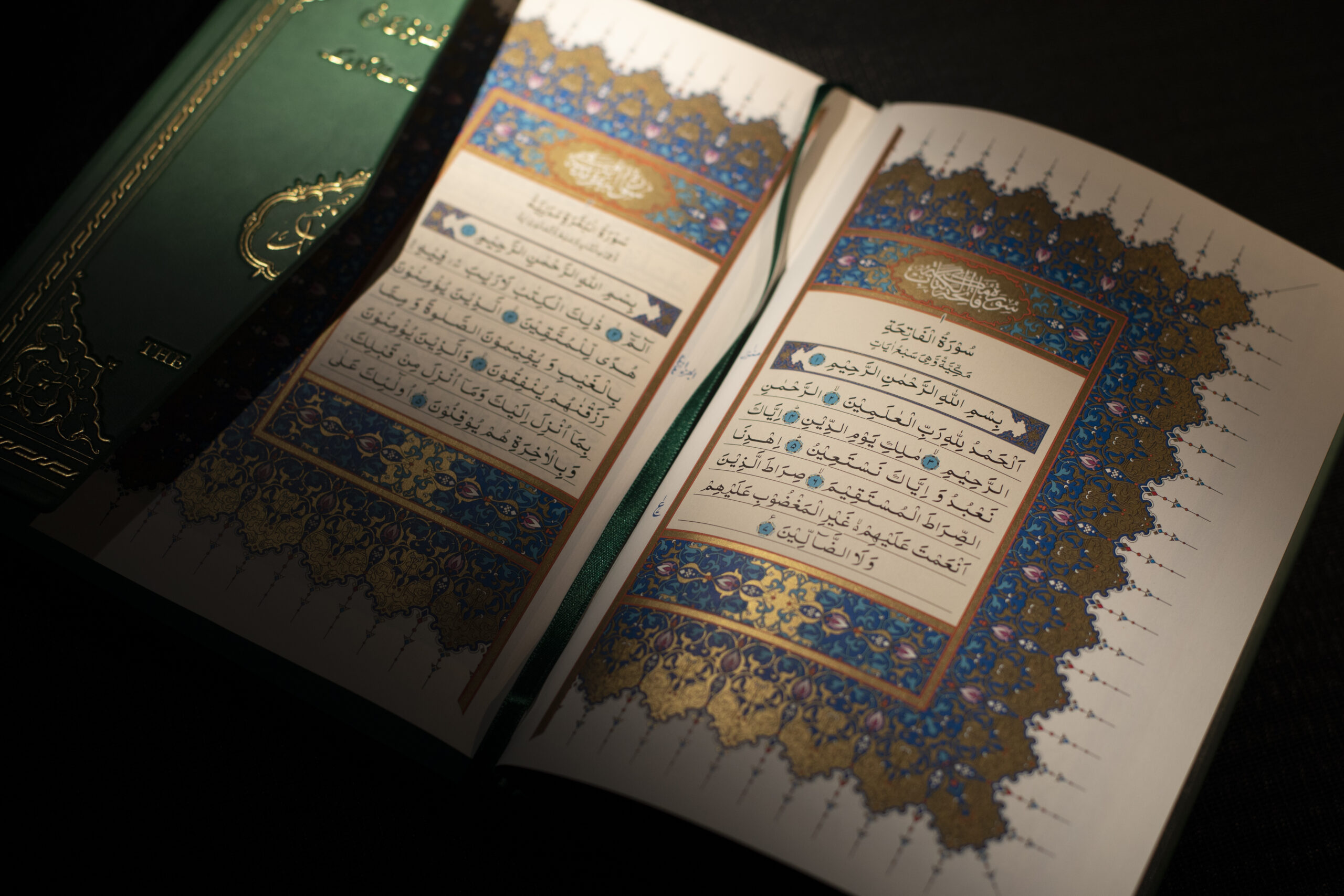
Finally, this condition calls us to gratitude. “All praise belongs to Allah, Lord of all the worlds” (Holy Qur’an, Surah al-Fatihah, 1:2). Gratitude is not words alone; it is recognising Allah as the source of every blessing and living accordingly. The Holy Prophetsa warned that any matter not begun with the praise of Allah remains deficient (Sunan Ibn Majah). The Promised Messiahas taught that true praise belongs only to Allah, as He alone possesses perfection in every attribute (Ruhani Khazain, vol. 15, pp. 598–602).
For Khuddam, this condition serves to draw their attention to the fundamentals of Islam. The five daily Prayers, tahajjud, durud, istighfar, and gratitude help to build a living relationship with Allah. To neglect them is to weaken our Bai‘at; to uphold them is to honour it.
“Taken from Conditions of Bai‘at & Responsibilities of an Ahmadi by Hazrat Khalifatul Masih Vaba.”

Education
Socialising at University
This article was originally written for the Student Review blog in collaboration with the Review of Religions (http://amsa.org.uk/studentreview)

A cold February weekend evening. Dressed in a black suit and bow tie, en route with friends to one of the poshest conference halls in the city for the most eagerly anticipated event of the departmental calendar year, attended by both students and lecturers alike. At 6pm a three course meal is served, followed by a short award ceremony and speech from the dean of the college. We all sit chatting contently and comfortably as the evening initially passes in a relatively tranquil fashion. However by 10pm the mood is very different.
I sit alone on a balcony, looking down at the desperate chaotic scene in the main hall below me. An evening of apparent class has descended into an alcohol-fuelled commotion. Their shamelessness strikes me the most, their adopting an attitude of living for the moment – forgetting the past and disregarding the future, lost in the life they consider so glamorous, like stray wolves wandering mountains, unaware of their ultimate purpose.
Such moments live inside me, as memories and as lessons. I realise now that to some degree all those that I watched from the balcony feel the same – joyful and excited on the exterior but secretly trapped inside their hearts like prisoners. I thought at that time of the blessing of the arrival of the Promised Messiah[as] and his mission to kill the swine – to destroy the culture of brazenness and flagrancy so that those who were imprisoned by this culture could realise the true meaning and purpose of life.
In many ways, there is a fine line between a heavenly and a hellish life. Sometimes the thing that you expect to lead you to happiness can turn out to be a source of pain and burning. When one seeks for superficial desires, and believes that something simple can fulfil the yearning of the heart, it in fact creates deeper holes and burns through the soul.
While I have been at University I have realised what my faith really is. It is not a source of oppression or rules or burdens; rather it bears my burdens and carries me through when I am lost, and picks me up when I stumble. For those who have not yet found God, who wander blindly from worldly pursuit to worldly pursuit, I realise that eventually it is they who are the losers. Living in their lusts and their drunkenness, they can gain temporary pleasure, but never peace or contentment or reassurance. They live a lonely life, really, moving from one temporary attraction to another, without goal, without direction, struggling through the difficult days and intoxicating themselves during the nights so they may push their troubles away. Moulding my university life in accordance with the teachings of God, or at least attempting to, liberates me profoundly. It means that my heart is at peace, that my troubles can be relieved by my prayers that I need not think of succumbing to the peer pressures that others have to face during their student days. It means that I can live my own life for the sake of God, and not try to live a more fashionable or socially acceptable life for the sake of others. And paradoxically, it means that others become drawn to the person who lives for God. Thus it enables me to set a trend, and not follow the sinful trends of others, even if it may only be to a small degree.
Making friends at university requires patience. To rush into attending freshers events as a desperate method of acquiring companions only leads to long-term failure. It may seem that you are an island, a lone wolf sheltered from the opportunities to meet people, but that feeling is only temporary. As the weeks pass, the realisation grows that the occasions to meet people are endless, without having to resort to being present at events in which alcohol is used as the only entertainment. University is about discovery. It is a crossroads, and enables one to make a choice about the kind of life one wishes to live. If we wish to forge friendships and be respected and admired by others, the tempting option will be to follow their tendencies and fashions and social habits. But what I have learnt is that only by following the path that God desires for us, and channelling our worldly passions according to God’s will, at a time in our life when they appeal to us most, can we ultimately acquire the truest friend and the most lasting peace.
“Verily, it is in the remembrance of Allah that hearts can find comfort” (13:29)
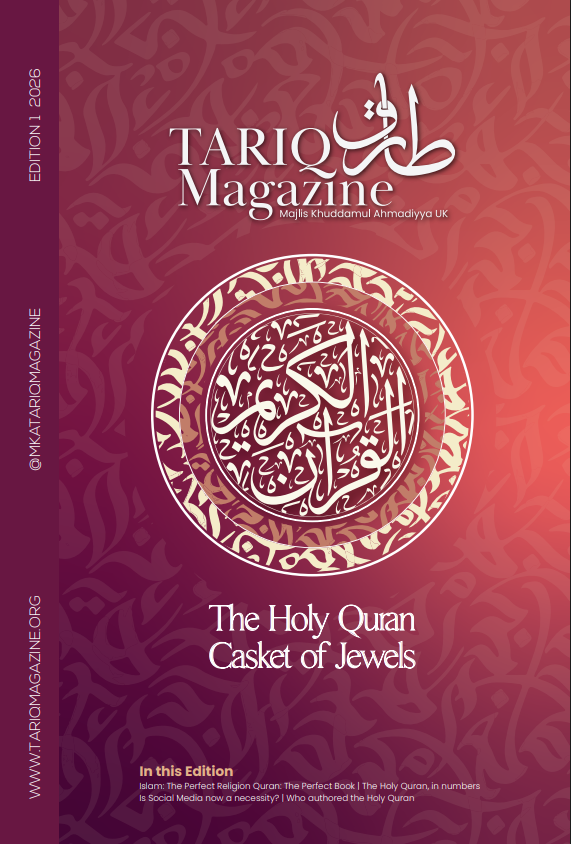
Get the Tariq Magazine through your letterbox each month.

A Spiritual and Moral Training

The Holy Quran – A Casket Of Jewels


